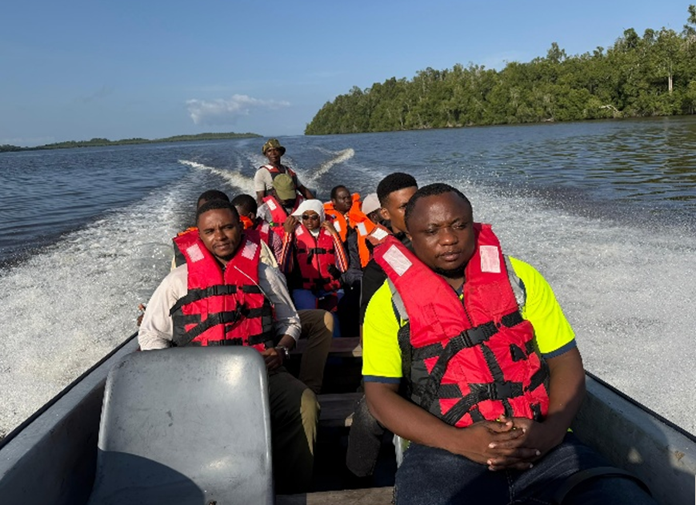
From February 19 to 28, 2026, ERAIFT (Regional Postgraduate School of Integrated Forest and Land Management in Tropical Regions) conducted hands-on field training as part of the course titled: 'Intersectoral and Integrated Approach: Forests, Agriculture, Livestock, Fishing, Tourism, Notions of Demography and Population Movements.' The focus was on: 'Economic Development of the Ecological Corridor of the Luki Biosphere Reserve – Mangrove Marine Park in the Democratic Republic of the Congo and the Dimonika Biosphere Reserve in the Republic of Congo, within the context of the Kivu–Ocean Green Corridor». This topic supports the initiatives of the Kivu–Kinshasa Green Corridor project, which promotes integrated territorial planning that balances conservation with economic growth, with the goal of establishing an ecological corridor between Luki–Muanda and Luki–Dimonika.
Over ten days, 80 learners from ERAIFT, spanning 13 African countries—including the Democratic Republic of the Congo, Cameroon, Gabon, Guinea, Mali, Benin, Togo, Senegal, Central African Republic, Niger, Republic of Congo, Burkina Faso, and Chad—deliberated on an integrated model for managing and developing the Luki–Muanda landscape. This model encompasses agriculture, agro-industry, livestock, tourism, mono- and multimodal infrastructure, biodiversity conservation, energy, fishing, and aquaculture.
The activities occurred primarily within the Luki Biosphere Reserve and the Mangroves Marine Park, key regions for conservation and sustainable development. Interactions with managers, local authorities, economic stakeholders, and nearby communities grounded academic insights in practical settings. These initiatives underscored the importance of inclusive governance, which involves multi-stakeholder consultation, comprehensive spatial planning, and the integration of socio-economic and environmental considerations issues.
The immersion also encouraged a learning-by-doing approach, enhancing critical analysis skills, data collection and processing capabilities, and the development of operational recommendations suited to the local context. Professionally, this experience strengthened teamwork in a multicultural environment and fostered collaborative leadership. It also helped participants better understand how demographic dynamics, pressures on natural resources, and opportunities for sustainable economic development interact.
ERAIFT would like to thank the European Union and NATURAFRICA for their financial support. ERAIFT would also like to thank AIDS and WWF for their support and renewed confidence. ERAIFT also thanks the Congolese Institute for Nature Conservation (ICCN) and INERA for welcoming the students to Muanda and Luki. Special thanks to PERENCO, site managers, and other stakeholders for welcoming the learners and their effective collaboration.