

News
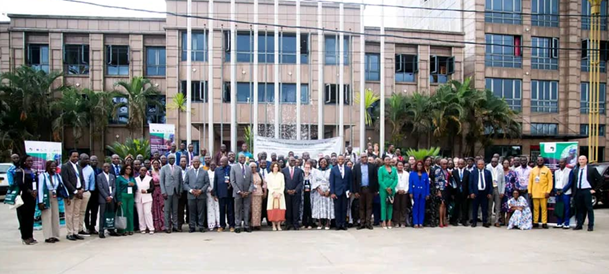
As part of the implementation of the project entitled: "Evaluation of the value of the Ecosystem Services of the Luki Biosphere Reserve (EVASE_RBL)", the ERAIFT was invited to present an oral presentation at the International Scientific Colloquium RESSAC on the theme: «Evaluation of the demand for ecosystem services by the populations living near the Luki Biosphere Reserve in DRC». This Symposium was organized from 25 to 27 November 2025, as part of the "Applied Research in Ecology and Social Sciences of Central African Forest Ecosystems (RESSAC)" program of CIFOR-ICRAF, with the theme "Forest Ecosystems of Central Africa", and funded by the European Union (EU).
This meeting brought together several stakeholders including scientists, NGOs, Civil Societies, and Governments, the main objective was to mobilize scientific expertise underregional on the key themes identified for the sustainable management of Central African forests in their triple dimension of ecological sustainability, economic profitability and social equity. More specifically, it was about: (1) sharing the salient results generated within the framework of the SURAC program by focusing on their policy and practical implications for the improvement of forest resource management and the well-to be indigenous peoples and local communities (IPLCs) in Central Africa; (2) explore opportunities for synergy and collaboration between teams of researchers and institutions on research themes in ecology and social sciences applied to the management of forest ecosystems in Central Africa ; (3) develop a summary document and a declaration to inform and guide the science-policy forum on the institutionalization of innovative research models in partnership on themes relevant for the sustainable management of forests in Central Africa; and (4) propose practical recommendations to take into account the results of this research in order to improve the legislative framework, political, cultural as well as the enhancement of IPLCs' rights and knowledge for better integrated and inclusive management of forest resources in Central African countries. This dialogue between science and policy aims to raise awareness among decision-makers in order to make decisions on sustainable forest management based on scientific evidence.
This high-level meeting was made possible thanks to the RESSAC program, implemented by the CIFOR-ICRAF consortium and funded by the European Union, to which the ERAIFT expresses its deep gratitude.
A delegation from the Regional Postgraduate School of Integrated Management of Tropical Forests and Territories (ERAIFT), led by its Director, Professor Baudouin Michel, and accompanied by Professor Lucie Temgoua, carried out an official mission to UNESCO Headquarters in Paris from 19 to 21 November 2025.
The purpose of the visit was to introduce the future Director of ERAIFT, Professor Lucie Temgoua, to UNESCO, with a view to ensuring institutional continuity and strengthening the strategic partnership with the Organisation’s scientific programmes. More broadly, the mission aimed to discuss the process and the technical and institutional requirements for the renewal of ERAIFT’s status as a UNESCO Category 2 Centre, as well as to identify new opportunities for collaboration in training, research and capacity building in the Congo Basin.
The delegation was received by the Division of Ecological and Earth Sciences, the Secretariat of the Man and the Biosphere (MAB) Programme, the Disaster Risk Reduction Section, the Intergovernmental Hydrological Programme (IHP), and the representative of the UNESCO Regional Office for Central Africa.
ERAIFT wishes to express its sincere gratitude to all UNESCO teams for their warm welcome, the richness of the discussions and their continued support for the School’s development. This mission marks an important milestone in strengthening cooperation with UNESCO and reaffirms ERAIFT’s strategic role in training and research for the sustainable management of tropical forests and territories in French- and Portuguese-speaking countries in Africa.
From October 27 to 31, 2025, the Regional Post-University School of Integrated Forest and Territorial Planning and Management, ERAIFT, a Category 2 center under the auspices of UNESCO, welcomes on its campus located at the University of Kinshasa, the 40 students of the 7th cohort of its regional master's program for the academic start this Monday, November 3, 2025.
This cohort consists of 40 learners from 11 countries, including Benin, Cameroon, the Republic of Congo, the Central African Republic, Gabon, Guinea, Niger, the Democratic Republic of the Congo, Togo, Chad, and Senegal. Among them, 9 are women, making up about 23% of the group. The 7th cohort runs simultaneously with the 6th, whose members are participating in a three-month immersion internship in the humid tropical rainforests of Odzala Kokoua Lossi National Park (PNOKL) in the Republic of Congo, gaining practical experience through hands-on learning.
This diploma's professional training begins with a common core during the first year of the master's program, where students learn the fundamentals of the systemic approach—ERAIFT's pedagogical and conceptual base. This approach is interdisciplinary, intersectoral, participatory, and embodies a comprehensive, integrated perspective, spanning November 2025 to October 2026 (semesters 1 and 2). The second year emphasizes specialization in semester 3 and the final thesis or project (TFE) in semester 4. Notably, specialization involves regional mobility at ERAIFT partner institutions, such as the Garoua Wildlife School (EFG, Cameroon) for the 'Protected Areas and Biosphere Reserves Management' (GAP/GRB) track, or the CRESA Forest-Wood (University of Dschang, Cameroon), or in managed forest concessions for the Forest Management Techniques (TAF) option. These programs are recognized by the African and Malagasy Council for Higher Education (CAMES).
On Thursday, November 6, 2025, at 2:00 PM, the ERAIFT conference room will host the public defense of doctoral candidate Bamenga Bopoko Lousi-Pasteur's thesis. The thesis, titled “Socio-economic Evaluation of Robusta Coffee (Coffea canephora Pierre ex A. Froehner) (Rubiaceae) in Tshopo Province, Democratic Republic of the Congo (DRC): Status and Potential,” analyzes perceptions among agents about their activities, assesses the impact of investments in the coffee sector and related environmental effects, and examines the governance framework of coffee production, focusing on institutional interactions, social benefits, and challenges. The study provides insights into revitalizing this sector in Tshopo Province.
ERAIFT thanks the Kingdom of Belgium for funding this research through grant B2/191/P1/CoffeBridge, and the Meise Botanical Garden for its collaboration. Finally, ERAIFT extends gratitude to its entire supervisory team.
Connect with us
Campus UNIKIN - BP 15373 - Kinshasa - Commune de Lemba - RD Congo